Can two words shift what flower someone imagines? I wanted to find out. Default choices fascinate me—what they are, how they form, and how to nudge them. To satisfy my own curiosity, I wanted to run the simplest possible experiment to understand people’s default choices and how they can be altered. I decided on the color of flowers—for no particular reason other than it was the simplest question I could think of and something everyone can relate to.
I ran two single open question surveys using Google’s Consumer Surveys. The first condition was: “You’re walking through a garden. You pick a flower. What color is it?”. The second condition was: “You’re walking through a bright, sunny garden. You pick a flower. What color is it?” — the only addition being the words bright and sunny.
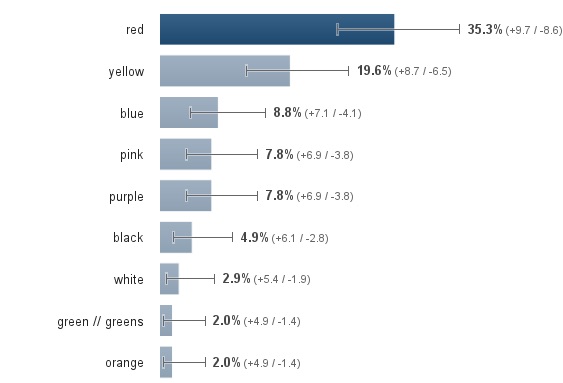
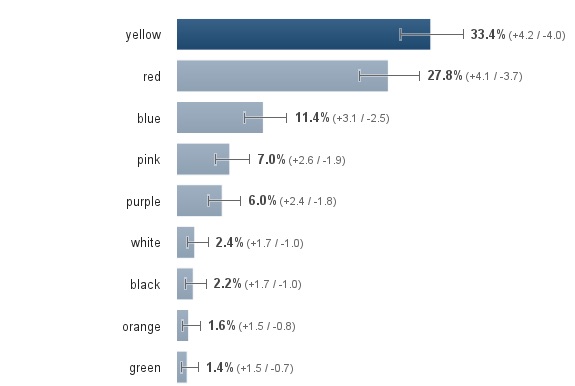
The consistency of answers and difference between the two conditions was bigger than I imagined for such a frivolous question. “Red” was the answer of more than one-third (35%) in the control condition and 28% in the bright-sunny condition — a pretty decent default.
But an interesting change occurred in the bright-sunny condition: There was a significant increase in the number of people who answered “yellow.” In the control condition, 20% of people defaulted to yellow, but with the addition of the bright-sunny text, this jumped to 33%.
Two words. A 13 percentage point swing. If environmental wording can change something as arbitrary as an imaginary flower, what else might it be nudging without us noticing?